
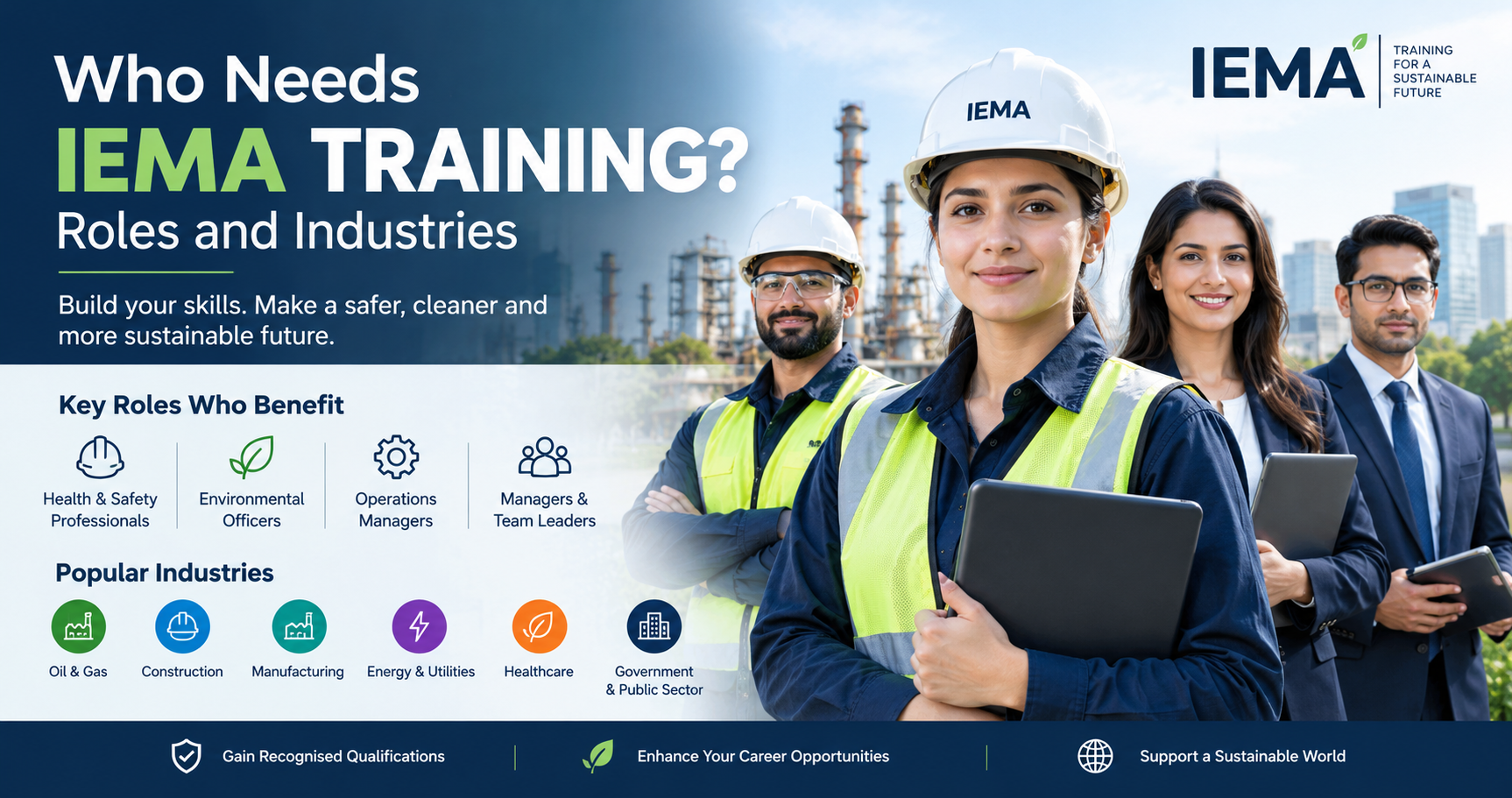
Who Needs IEMA Training? Signs It Is Right for You
Environmental responsibility is no longer only a job for specialists. Clients, regulators and employers now expect many teams to understand how their work affects the environment. So who needs IEMA training? This guide shows which roles and industries benefit most.
Roles that benefit from IEMA training
- HSE officers and managers. You already manage safety. IEMA training adds the environmental side, so your profile covers health, safety and environment together.
- Site engineers and construction supervisors. Your work affects waste, pollution, materials and energy use every day.
- Operations and quality managers. You run processes where environmental performance is part of the job.
- Compliance and risk professionals. You need to understand environmental legislation and how organizations meet it.
- ISO and management system professionals. Environmental management knowledge helps you work with systems such as ISO 14001.
- Graduates and career changers. You want a clear starting point for a career in environment or sustainability.
Industries where it is useful
- Construction and infrastructure
- Manufacturing and industrial production
- Oil, gas and energy
- Facilities management
- Logistics and transport
- Consulting and training
IEMA training for manufacturers
Manufacturing teams deal with waste, emissions, energy use and material efficiency. IEMA training gives production, quality and operations staff a shared language for environmental topics, so improvements are easier to plan and explain.
IEMA training for HSE professionals
Many companies now combine health, safety and environment under one team. If you hold a safety qualification such as an NVQ in occupational health and safety, IEMA training adds the environmental knowledge that completes your profile.
Signs IEMA training may be right for you
- You are asked to collect or report environmental data
- Clients or auditors ask about your environmental performance
- You are moving from a safety role into a health, safety and environment role
- You want to understand ISO 14001 better
- You are starting a sustainability career and need a solid foundation
What you gain from IEMA training
- Knowledge of core environmental principles
- Awareness of environmental legislation and compliance
- An understanding of environmental management systems
- Confidence to bring environmental thinking into planning and decisions
Who may not need it right now?
If your role is purely technical and has no link to environmental performance, other qualifications may serve you better first. A good training provider will help you decide instead of selling you the wrong course.
How to get started
- Write down your current role and your career goal.
- Check the IEMA course that fits your level.
- Confirm duration, exam format, entry requirements and fees with the provider.
- Enroll and plan regular study time around your work.
Not sure where to begin? Read our beginner’s guide: What Is IEMA Certification?
Who Needs IEMA Training? Frequently Asked Questions
Who should take IEMA training?
Anyone whose work affects or reports on environmental performance, including HSE professionals, engineers, supervisors, quality and compliance staff, and graduates starting an environmental career.
Is IEMA training only for people in environmental roles?
No. Many people in safety, construction, manufacturing and operations take it to add environmental knowledge to their profile.
Can HSE professionals benefit from IEMA training?
Yes. It adds the environmental side to health and safety knowledge, which suits combined HSE roles.
Do I need a degree to start?
It depends on the course and provider. Always confirm the entry requirements for the course you choose.
Ready to take the next step?
See our IEMA certification courses page, or message us with your role and goal and we will guide you to the right option.