
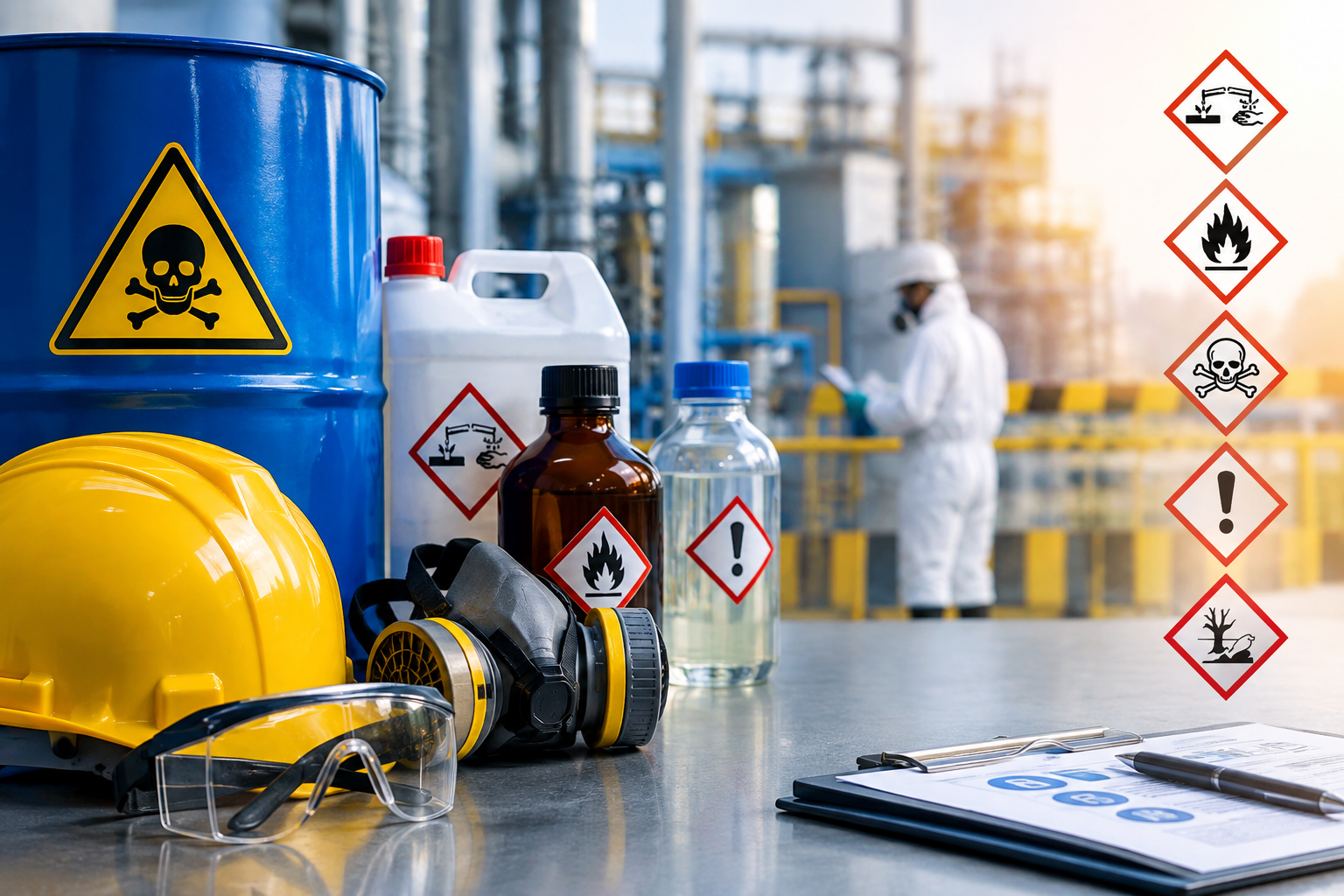
Chemical Hazards in the Workplace What Every Employer Needs to Get Right in 2026
Most chemical injuries at work don’t happen the way people picture them. There’s rarely a dramatic spill or a visible cloud of smoke. More often, it’s a worker who’s been degreasing parts with the same solvent for two years and starts noticing headaches he can’t explain, or a cleaner whose gloves wore through three shifts ago and nobody replaced them. Chemical hazards tend to build quietly which is exactly why they’re so easy for a business to underestimate until an audit, an inspection, or an incident forces the issue.
This guide walks through what actually counts as a chemical hazard, how the rules around labelling and classification have shifted heading into 2026, and what a workplace needs in place to control the risk properly rather than just document it.
What Counts as a Chemical Hazard?
A chemical hazard is any substance solid, liquid, gas, dust, or vapour capable of causing harm to a person, to property, or to the surrounding environment if it isn’t handled, stored, or disposed of correctly. That definition covers a lot more ground than most site managers assume. It’s not just the drums in the chemical store. It’s the industrial degreaser in the maintenance bay, the adhesive used in a workshop, and the bottle of concentrated cleaning solution sitting under an office pantry sink.
Whether a substance actually behaves as a hazard depends on three things working together what the chemical is capable of, how it’s being used, and how much exposure a worker realistically gets. A solvent sealed inside a closed industrial process poses very little risk. That same solvent used for manual wipe-downs in a poorly ventilated room is a completely different story. This is why a proper hazard assessment always looks at the actual task, not just the label on the container.
The Three Categories of Chemical Hazards
Safety professionals sort chemical hazards into three groups, and the grouping isn’t just administrative each category demands a different response.
Physical Hazards
These come from a chemical’s own properties rather than its toxicity. Flammable liquids, compressed gases, and oxidising agents fall here, and the danger is fire, explosion, or a violent reaction rather than poisoning. A large share of physical-hazard incidents trace back to something as simple as storing incompatible chemicals side by side an oxidiser next to a flammable solvent, for instance rather than any exotic failure.
Health Hazards
Health hazards act on the body, and the timeline matters here. Some, like corrosives, cause damage the moment they touch skin. Others certain solvents, dusts, and carcinogenic substances cause harm that only surfaces after months or years of low-level exposure. This delayed pattern is precisely why workers and supervisors shouldn’t wait for obvious symptoms before treating a substance seriously.
Environmental Hazards
These affect ecosystems rather than people directly soil contamination, water toxicity, harm to aquatic life. A spill that never touches a single employee can still create a serious regulatory and environmental problem if the substance is persistent or toxic to the surrounding environment. Businesses operating across the Gulf and South Asia in particular need to factor this in, since environmental hazard classification isn’t treated identically everywhere and local regulators increasingly expect it to be documented.
The Rules Just Changed Here’s What’s Actually Current
If you read an older article on chemical hazard compliance, it probably tells you manufacturers had until January 2026 to update Safety Data Sheets and labels under the revised Hazard Communication Standard. That deadline has since moved. OSHA extended every phase of the rollout by four months in a rule published in January 2026, which means the real, current schedule looks like this:
- Manufacturers, substances extended to May 19, 2026 (already in effect)
- Employers, substances updating in-house labels, HazCom programs, and worker training ,extended to November 20, 2026
- Manufacturers, mixtures extended to November 19, 2027
- Employers, mixtures extended to May 19, 2028
The practical takeaway for employers: if your business handles hazardous substances, the deadline to update your written hazard communication program, retrain staff, and revise workplace labelling is now this November not next year, and not “sometime soon.” Waiting until the deadline is close usually means scrambling, because training and documentation updates take longer than most safety officers expect once you factor in staff schedules and shift patterns.
Globally, the same direction of travel applies through the Globally Harmonized System (GHS), which standardises hazard pictograms, signal words, and hazard statements so a warning label means the same thing whether it’s read in Dubai, Riyadh, or Lahore. If your organisation operates across more than one country, this consistency is genuinely useful but it only works if the people reading those labels have actually been trained to interpret them correctly.
How to Actually Identify Chemical Hazards on Site
Start with the paperwork, but don’t stop there. Every hazardous substance should have a Safety Data Sheet available on-site, covering exposure limits, required protective equipment, and emergency response steps. A label tells a worker there’s a danger; the SDS tells them what to actually do about it.
Walk the process, not just the storeroom. A proper risk assessment accounts for every route of exposure inhalation, skin contact, ingestion and checks how a substance is used day to day, not just how it’s stored. The same chemical can be low-risk in a sealed system and genuinely dangerous during manual transfer or cleaning.
Pay attention to the body’s own signals. Recurring headaches, skin irritation, or unexplained fatigue among a specific team is often the earliest sign of chronic low-level exposure frequently well before a paperwork review would catch it. Supervisors who treat these complaints as data worth investigating, rather than one-off grumbles, close a gap that documentation alone can’t.
Controlling the Risk The Hierarchy That Actually Works
Not every control measure carries equal weight, and this is one of the most misunderstood parts of chemical safety. The internationally recognised hierarchy of controls ranks five approaches from most to least reliable:
- Elimination removing the hazardous substance from the process entirely.
- Substitution replacing it with something less harmful (a water-based product instead of a solvent-based one, for example).
- Engineering controls isolating people from the hazard physically, through local exhaust ventilation, fume extraction, or enclosed transfer systems.
- Administrative controls hanging how people work around the hazard: rotating staff to limit exposure time, scheduling higher-risk tasks for low-occupancy hours, clear signage.
- Personal protective equipment gloves, respirators, goggles, coveralls.
The order matters because the top of the list works independently of human behaviour, while the bottom depends entirely on someone doing the right thing correctly, every single time. A business that leans mainly on PPE without exploring elimination or substitution first is usually protecting itself on paper more than it’s protecting the person on the floor.
Getting PPE Right (And Where Most Sites Get It Wrong)
PPE selection has to follow the Safety Data Sheet, not a general assumption. A glove rated for one chemical family can fail almost instantly against another and using the wrong glove is arguably worse than using none, because it creates false confidence. Respirator selection depends on measured or estimated airborne concentration, not on how strong a smell seems.
The most common failure isn’t a missing glove or a forgotten mask. It’s misuse gloves worn well past their safe lifespan, protective equipment removed the wrong way so contamination transfers straight onto skin, or workers skipping eye protection for a task they’ve decided is “quick.” These patterns almost always trace back to gaps in training rather than carelessness, which is really the heart of the next section.
When Something Goes Wrong Emergency Response Basics
The first few minutes after a chemical incident decide how it ends. A few non-negotiables:
- Identify the substance from its label or SDS before attempting any containment the wrong response (water on a reactive chemical, for instance) can make things dramatically worse.
- Spill kits need absorbents matched to what’s actually stored on site, not a generic all-purpose kit.
- Skin contact calls for continuous flushing with water for at least fifteen minutes; contaminated clothing comes off as soon as it’s safe to remove it.
- Eye exposure needs an eyewash station immediately delay here is what turns a manageable injury into permanent damage.
- Inhalation cases need fresh air and monitoring straight away, since some respiratory symptoms surface only after a delay.
Every case, even one that seems to resolve on its own, deserves a medical follow-up. Internal chemical injuries can progress well after the visible reaction has settled.
Why Training Is Where Most Safety Programs Actually Fail
A written policy that nobody understands under pressure isn’t protecting anyone. Effective training goes past a slideshow of hazard pictograms it means walking a worker through the specific SDS relevant to their actual job, practising how to put on and remove PPE correctly, and running real spill-response drills rather than talking through them once a year.
Training also has to be role-specific. A warehouse worker moving sealed containers faces a different exposure profile than a technician performing manual chemical transfers, and treating both groups identically wastes time while leaving real gaps. This is also where a structured, recognised safety qualification pays for itself a program built around scenario-based learning gives supervisors and safety officers the depth to actually run risk assessments and manage controls, rather than just tick a compliance box once a year.
Building This Into an Ongoing System, Not a One-Time Fix
Chemical inventories change. New products enter a site, processes shift, and regulations move — as the 2026 HazCom extension shows, even the deadlines themselves aren’t fixed. A safety program built for a single audit cycle will eventually fall behind. Reassessing risk whenever a new substance or process is introduced, rather than waiting for an annual review, is what actually keeps a workplace ahead of the problem instead of reacting to it.
Frequently Asked Questions
What exactly is the current deadline for HazCom compliance in 2026?
Manufacturers had until May 19, 2026, to update labels and Safety Data Sheets for substances. Employers now have until November 20, 2026, to update workplace labelling, their written HazCom program, and worker training extended four months from the original July 2026 date.
Can one chemical be both a physical hazard and a health hazard at the same time?
Yes. Many solvents, for example, are both flammable and toxic if inhaled, which means the controls need to address fire risk and exposure risk simultaneously, not just one or the other.
What’s the real difference between a chemical label and a Safety Data Sheet?
A label gives an immediate, simplified summary visible on the container. The SDS is the full technical document usually 16 sections covering exposure limits, handling, storage, and emergency measures.
How often should a workplace chemical risk assessment be redone?
Whenever a new substance enters the site, a process changes, or a regulation updates not on a fixed annual schedule alone. A calendar-based review misses real-time changes in exposure.
Why does PPE sit at the bottom of the control hierarchy if it’s the most visible measure?
Because it only protects the person wearing it, and only when used correctly every time. Elimination, substitution, and engineering controls remove or reduce the hazard itself, which is inherently more reliable than depending on consistent human behaviour.
Does GHS labelling apply the same way everywhere, including outside the US?
The core system pictograms, signal words, hazard statements is designed to read the same globally, which is genuinely useful for organisations operating across multiple countries. Local regulators can still layer their own additional requirements on top, so it’s worth checking country-specific rules rather than assuming full uniformity.
Want your safety team trained to handle chemical hazards the right way, not just on paper? Prime Educational Hub structures its HSE and workplace safety training around real scenarios your team will actually face on site.